Image

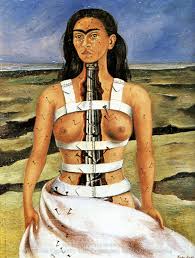
The Broken Column

‘I hope the leaving is joyful and I hope never to return’

-Frida Kahlo.

Frida Kahlo de Rivera was a Mexican artist who painted many self portraits and was known for her Naïve folk art style. Her paintings often had strong autobiographical elements and mixed realism with fantasy. When Frida was sex years old, she contracted Polio leaving her right leg shorter and thinner than the left one. She was bullied and harassed at the school. Soon, she was forced to leave school. She then went to a Mexican school and fell in love with the culture.  She enjoyed art at an early age and filled her notebooks with sketches.

On 17 September 1925, Kahlo and her boyfriend – a fellow Cachucha, Alejandro Gómez Arias – were on their way home from school when the wooden bus they were riding collided with a streetcar. The accident killed several people and fractured Kahlo’s ribs, both her legs, and her collarbone. Kahlo suffered near fatal injuries. An iron handrail impaled her through her pelvis, fracturing the pelvic bone. She spent a month in the hospital and two months recovering at home before being able to return to work. As she continued to experience fatigue and back pain, her doctors ordered x-rays, which revealed that the accident had also displaced three vertebrae. Her treatment included wearing a plaster corset which confined her to bed rest for part of the three months she spent unable to walk. The accident ended Kahlo’s dreams of becoming a doctor and caused her pain and illness for the rest of her life; her friend Andrés Henestrosa stated that Kahlo “lived dying”. During her recovery, she started to consider a career as a medical illustrator, which would combine her interests in science and art, and began to paint. She had a specially-made easel that enabled her to paint in bed, and a mirror was placed above it so she could see herself . Painting became a way for Kahlo to explore questions of identity and existence, and she later stated that the accident and the isolating recovery period made her desire “to begin again, painting things just as she saw them with her own eyes and nothing more.” Most of the paintings Kahlo made during this time were portraits of herself, her sisters, and school friends.

THE PAINTING

Pain and suffering is a constant topic in Frida’s painting. In this painting, The Broken Column, Frida expressed her anguish ans suffering in a most straightforward and horrifying way. In this painting Frida looks pretty and strong. Although her whole body is supported by the corset, she is conveying a message of spiritual triumph. She has tears on her face but she looks straight ahead and is challenging both herself and her audience to face her situation.

The style of this painting is very unique. She laid down each stroke firmly to build a simple and clear image. There are no virtuoso flourishes of the brush and the colors are as neatly contained within contours. At the beginning she paints herself nude but later covered her lower part up with something that looks like a hospital sheet. A broken column is put in place of her spine. The column appears to be on the verge of collapsing into a rubble. Penetrating from loins to chin, the column looks phallic, and the sexual connotation is all the more obvious because of the beauty of Frida’s breasts and torso.  There is a difference between isolation and solitude.

The painting portrays her strong character and depicts the pain that she’s gong through. This Canvas work is considered to be one of the best artwork till date.
Continue reading

Gallery

10 Mysteries Hidden In Famous Paintings.

1. Vincent van Gogh’s Self-Portrait with Bandaged Ear depicts the artist with an injured right ear. In reality, he cut off his left ear. The discrepancy is explained by the fact that Van Gogh used a mirror to create the picture of himself.

2. If you look closely at The Old Guitarist by Pablo Picasso, you can see a dim female silhouette behind the man’s head. After taking infrared and X-ray images of the painting, researchers from the Art Institute of Chicago discovered a few other shapes hidden underneath. Most likely, the artist didn’t have enough money to buy new canvases and had to paint over old ones.

3. During the restoration of Rembrandt’s The Shooting Company of Frans Banning Coco and Willem van Ruytenburch (better known as The Night Watch) in 1947, it was cleaned of a thick layer of soot. After that, it became evident that the scene portrayed in the painting takes place not at night but in daylight.

4. An image of the human brain is discernible not only in The Creation of Adam by Michelangelo but also in another fresco of the Sistine Chapel: The Separation of Light and Darkness. Look at God’s neck: if you superimpose it onto a photo of the human brain as seen from below, you’ll get a perfect overlap of the lines.

5. The figures of David and Goliath in another fresco of the Sistine Chapel created by Michelangelo form the Hebrew letter gimel, which symbolizes strength in the mystical Kabbalah tradition.

6. Margaret Livingstone and Bevil Conway studied Rembrandt’s self-portraits and proved that the painter suffered from stereo blindness. This peculiarity made the painter perceive the world a little differently: he saw reality in 2D instead of 3D. However, it is possible that stereo blindness helped Rembrandt create his immortal masterpieces.

7. One of the most famous paintings by Gustav Klimt portrays Adele Bloch-Bauer. It was commissioned by her husband, the sugar baron Ferdinand Bloch-Bauer. He found out that Adele and Klimt had an affair and believed that after hundreds of sketches the painter would come to hate his mistress. Routine work really made the feelings between the sitter and the artist cool down.

8. That is not the only mystery of Last Supper. The hands of Christ and the apostles, along with the loaves of bread on the table, form something that could be read as a musical notation. Upon testing, it does sound like a short tune.

9. Almost all the paintings of Vincent van Gogh feature a dominant yellow. Professor Paul Wolf explains that as a side effect of an epilepsy remedy that changes color perception. The artist’s world could really look the way we see it in his canvases.

10. There is a solid evidence that Wolfgang Amadeus Mozart was a Mason. Even in his child portrait by Pietro Antonio Lorenzoni, we can see a Masonic symbol: a hidden hand that indicates a hierarchical rank in the secret society.

The links for the same are given below :

1. Vincent Van Gogh’s self portrait

2. The Old Guitarist  

3. The night watch

4. The separation of light and darkness

5. Rebrandt’s Self Portrait

6. David And Goliath in Sistine Chapel

7. Gustav Klimt

8. The Last Supper

9. Wheatfield with Crows

10. Childhood portrait of Mozart


Thank you for Reading ! 🙂


Top 3 Indian Painters of all times.

1. Maqbool Fida Hussain :

M.F. Hussain was born in Pandharpur Maharashtra. Primarily a self-taught artist, Husain was part of the revolutionary Progressive Artists’ Group. In 1947 his first exhibition was conducted at the Bombay Art Society where his painting Sunhera Sansaar was shown. From 1948 to 1950 there were a series of exhibitions of Hussain’s paintings all over India. By 1960s, his paintings were exhibited in the art galleries of Prague and Zurich. Hussain soon became a name synonymous with modern Indian art due to his fearless depiction of his imagination, as well as, his willingness to absorb international influences. However, most of his work since his formative years has been rooted in an Indian vocabulary and aesthetics.

The Padma Bhushan awardee still reins number one on the list due to the enduring and unmatched recognition he earned globally. However, Hussain faced several challenges in the way of controversies and criticism regarding the depiction of religious figures in his paintings. Even so with his unmatched global recognition, this list is firmly led by his legacy.

 2. Francis Newton Souza :

Another artist who irreversibly shaped and transformed the Indian art landscape was the F.N.Souza—the one who first invited Hussain to join the Progressive Artists’ Group. He led the newly independent India’s avant-garde movement. However, Souza drew tremendously from international influences to an extent that he was often referred as the “Indian Picasso”. His subjects often depicted the human figure, frequently distorted. These figures would often embody a sense of eroticism and present itself in the form of a religious dilemma.

Born to a strict Roman Catholic family in the Portuguese colony of Goa in 1924, his upbringing was marked by what he saw as the conflict between the erotic Indian art surrounding him, and the repressive teachings of the Catholic Church. This duality of what he called ‘sin and sensuality’ was to significantly shape his art. Souza’s canvases alternate from spiky, deformed faceless bodies and violent scenes of Christ’s crucifixion, to sensual and statuesque nudes and tender portrayals of mother and child.

3. Syed Haider Raza :

S.H.Raza—one of the founding members of the Progressive Artist’s Group started painting themes from his childhood memories spent in his native village of Babaria, in Madhya Pradesh. Raza known for his abstract geometric colourful canvases started off as a landscape artist. Following his move to Paris, his landscapes were noticeably more rigid and geometric reminiscent of the French landscape in the 1950s.

By the 1970s, the artist began creating what is now easily identifiable as Raza’s style—geometric, bright, colorful  patterns. He attempted to map out metaphorical spaces with the central ‘bindu’ as the sanctified motif. Today his artworks are probably the most easily recognize his unique mandala-like creation stands out as his unique vision. Raza has widely exhibited in India and abroad. He was awarded the Padma Shree in 1981.

Read also :  Top 50 artists 


Thank you for reading ! 🙂

Image

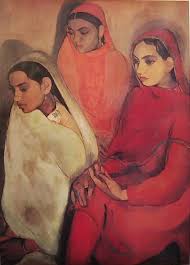
Group Of Three Girls

Amrita Sher-Gil , a well known painter painted the famous ‘Group Of Three Girls’ in the year 1935. It is a Oil on Canvas painting. She has been called a “pioneer” in the Modern Indian Art. Her place in the trajectory of Indian Modern Art is pre-eminent. Her Aesthetic sensibility shows a blend of European and Indian elements. She was born and brought up in Hungary. At age sixteen she traveled with her mother to Paris to train as a painter and so her early paintings displayed a significant influence of Western modes of painting.

THE PAINTING

The ‘Three Girls’ won the gold medal in the annual exhibition of the Bombay Art Society in 1937. The award launched Amrita, who was to be celebrated later as the first lady of the Indian canvas and influence generations of modern painters in India.

Details

Title :  Group of Three Girls

Creator : Amrita Sher-Gil

Location : Amritsar

Date Created : 1937

Type : Oil On Canvas Painting

The painting shows three colorfully dressed women contemplating a destiny they are unable to change. Amrita Sher-Gil did not sensualise her women but instead portrayed them as facing great adversity yet having the spirit to transcend a destiny that they were unable to change. It also marks Sher-Gil’s move from an earlier academic and realist style of painting that she had learned in Paris towards a flatter style with modern compositions, where line and color are prominently used. In  Three Girls, the girls’ surrounding is not shown. Their situation is made evident through their facial expressions, their body language, and the skillful use of tones. The three girls in the painting were actually sisters and came to meet Amrita in the due course of her stay in India. She was so overwhelmed by them that she actually ended up painting their Portraits.

Group of Three Girls Article.


Thank you for reading 🙂

Image

Radha-Krishna-Rukhmini.

‘ A picture is a poem without words’

– Horace.

THE PAINTING

Modern Art has always been one of my favorite art forms of all the times. This painting of Lord Krishna is one of my favorite from my collection of paintings. The painting above is of Lord Krishna with Radha to the left and Rukhmini to the right. Rukhmini was  Lord Krishna’s wife and hence you can see that Krishna is slightly inclined towards Rukhmini. It took me five days to complete the drawing and another two weeks to complete the painting. This painting is done using the Modern Art style. In Hindu Mythology, the Gods are shown wearing too many gold ornaments and are painted using bright colors and then there’s a lot of detailing work that goes into it. Even the figures are tiny and quite sharp. Here, I’ve simply done a shading using strokes and not given too much detailing to a character.

LORD KRISHNA

Colors used for strokes and shading are Black, Persian blue, Sky Blue and White. The color of his face is not too dark and not too light. I’ve simply given a wash of Light Blue to the face. The body has vertical shading starting with White then a lighter shade of blue and finally a darker one. Its a simple shading with patches of Black in between. There is also a cap like turban on his head to make it look more artistic.

RADHA AND RUKHMINI

The colors used in these figures are White, Grey and Black. Again a simple vertical light-to-dark tone shading has been done here with patches of black in between. A really interesting thing that you may observe here is that Lord Krishna and Radha are standing very close to each other whereas Lord Krishna is more inclined towards Rukhmini but the level of proximity is not that close.

THE BACKGROUND COLOR

The background color is a shade of White, light blue and dark blue towards the left and a shade of Crimson Red towards the right. Surprisingly, the only color between the two backgrounds that merges both the colors is Yellow! A slight tint of it makes it more lively. There are flowers on either sides of the painting. They don’t have any resemblance here. The border surrounding Lord Krishna is Dark Blue that merges into the Crimson Red on the other side.

I had painted this roughly five years before and the colors are still the same. It was painted on an A3 sheet and the colors used were Poster and Acrylic paints. No oil paint was used.

Thank you for reading this 🙂

Image

The Starry Night.

‘The Starry Night” is an oil on Canvas painting by the famous artist ‘Vincent Van Gogh’. He painted it in the year 1889 during his stay in the Asylum. The painting somewhat depicts the view from the east facing window of his asylum room at the Saint Rèmy-de-Provence. It’s a magnificent piece of art. Honestly, the painting’s fame has been extended than that of its creator.

THE ASYLUM

Vincent admitted himself in the asylum  as he had been diagnosed with epileptic fits. His mental condition began to improve but soon it relapsed. He began to suffer hallucination and have the thoughts of suicide as he plunged into depression. Accordingly, there was a tonal shift in his work and eventually he began to incorporate darker colors and The Starry Night is a wonderful example of that shift. During his stay at the asylum, Vincent wrote letters to his brother Theo. The Starry Night was painted in mid-June 1889, the day he wrote a letter to his brother Theo saying that he had a new study about the starry sky.

THE PAINTING

The beauty of The Starry Night is timeless and universal. Vincent painted variations of the same painting of no fewer than twenty-one times. In his letter to his brother Theo, he wrote, “Through the iron barred window, I can see an enclosed square of wheat…above which in the morning, I watch the sun rise in all it’s glory.”                  He depicted this view at different times of the day and under different weather conditions – sunrise, moon-rise, sunshine filled days, overcast,windy days and days filled with rain.

Blue dominates the painting, blending hills into the sky. The little village lays at the base in the painting in browns, greys and blues. Even though each building is clearly outlined in black, the yellow and white color of the moon and the stars stand out in the bright blue sky. Speaking of the sky, Vincent in his letter to Theo wrote about the brightest star in the painting. It says ” This morning, I saw the countryside from my window a long time before Sunrise with nothing but the morning star, which looked very big.”     Researchers refer to this morning star as Venus. So, the brightest star in the painting right next to the Cypress tree is actually Venus. Again, every element in the painting has been symbolized in one form or another. This painting is only his imagination. This was not the actual view from his room. Analysts of The Starry Night emphasize on the symbolism of the stylized cypress tree in the foreground, linking it to death and Van Gogh’s eventual suicide.

The contrast in styles plays on the natural versus the unnatural and dreams versus the reality. The brush strokes for the sky swirl around the clouds with each dab of color rolling around the stars and the moon. The hills easily roll down into the village below and on the cypress tree they bend with the curve of the branches. Divide the painting into three parts. The sky is the divine. It is by far the most dreamlike part of the painting, beyond human comprehension and just out of reach. Go down one level to the cypress and the hills and the other trees on the ground, they bend and swirl matching the swirls like that of the sky. The last part is the village. The straight rigid lines divide it from the rest of the painting. However, note the dots of trees rolled through the village, how the spire of the church stretches up to the sky. Van Gogh brings God to the village.

As a man who paints what he sees, this one’s a remarkable break from Vincent Van Gogh’s  normal work.

Thankyou so much for reading 🙂

My Introduction to Modern Art.

‘ I dream about painting and then I paint my dream.’

-Vincent Van Gogh

As an eight year old kid, I absolutely loved to draw. I had seven-eight coloring books that were gifted to me on my birthday. My joy had no bounds when I was gifted a painting kit. The colors made me feel so alive! Back at that time, we were told to make simple drawings in school such as a scenery or a fruit basket or maybe a flower vase.

One day, my mother decided that I should go to an art class so that I get to spend some more time with my drawings and get to improve them of course! By far, I feel that it was the best decision I ever took in my life! :p . I went there and I experienced something different. Maybe the vibe of it made me feel so happy and alive. I used to be an introvert before and pretty awkward to talk to at times but there I began to mix up with people and I explored a new me. I drew, I painted and  moreover I felt that there was something about the place, the students, the teacher there. Talking about the place, the art class takes place in her 1 BHK apartment where fifty students sit in a batch! Its crazy because half of them sit in the hall-room spreading it till the kitchen and then the bedroom. I spent nine long years in art class and in this span of nine years we grew as a family. I gave my Elementary and Intermediate examinations and later learnt that there were infinite art forms that were so popular yet so underrated.

One such art form that  I learnt was Modern Art, an art form prevalent between the late 18th and 19th century. My art teacher introduced it to me and this may sound very cliche but it was something like love at first sight. Not kidding! She gave me paintings so that I could replicate them and I drew many! Famous painters like Pablo Picasso, Vincent Van Gogh, Salvador Dali etc. were responsible for the development of Modern Art. Their Famous paintings such as The Starry Night, The weeping Woman, Irises are some of the renowned works in Modern Art.  People always tend to confuse it with Contemporary art or Abstract art. Its an art form on its own and doesn’t need any other form to describe it.

Such was my approach towards Art and how I got acquainted with it. Every artist paints with the motive of letting out all his/hers feelings and that’s what makes it more special. For me, every art has a story and an emotion behind it and that’s how it “comes to life.”

Thanks for reading! See you soon. Ciao! 🙂

Art Attack!

What is art? How many amongst us actually love and understand art? How do you define art?   Phew!  Too many questions!

Well, for me Art is something that I always see around me. Something that is quite aesthetic and fascinating , even the scenary surrounding you. Art has its own language and so it communicates in a different way to each one of us. Example, when we say the word scenary, we picture mountains, trees, sun, birds etcetra maybe because we’ve been used to the same old technique of drawing a scenary.

So, here I am with a blog where I’ll be posting some of my art works and will be writing about the same too. We as an a audience fail to understand art. Come join with me in this journey of getting all artistic….. because every art speaks, can you tell?