‘I hope the leaving is joyful and I hope never to return’
-Frida Kahlo.
Frida Kahlo de Rivera was a Mexican artist who painted many self portraits and was known for her Naïve folk art style. Her paintings often had strong autobiographical elements and mixed realism with fantasy. When Frida was sex years old, she contracted Polio leaving her right leg shorter and thinner than the left one. She was bullied and harassed at the school. Soon, she was forced to leave school. She then went to a Mexican school and fell in love with the culture. She enjoyed art at an early age and filled her notebooks with sketches.
On 17 September 1925, Kahlo and her boyfriend – a fellow Cachucha, Alejandro Gómez Arias – were on their way home from school when the wooden bus they were riding collided with a streetcar. The accident killed several people and fractured Kahlo’s ribs, both her legs, and her collarbone. Kahlo suffered near fatal injuries. An iron handrail impaled her through her pelvis, fracturing the pelvic bone. She spent a month in the hospital and two months recovering at home before being able to return to work. As she continued to experience fatigue and back pain, her doctors ordered x-rays, which revealed that the accident had also displaced three vertebrae. Her treatment included wearing a plaster corset which confined her to bed rest for part of the three months she spent unable to walk. The accident ended Kahlo’s dreams of becoming a doctor and caused her pain and illness for the rest of her life; her friend Andrés Henestrosa stated that Kahlo “lived dying”. During her recovery, she started to consider a career as a medical illustrator, which would combine her interests in science and art, and began to paint. She had a specially-made easel that enabled her to paint in bed, and a mirror was placed above it so she could see herself . Painting became a way for Kahlo to explore questions of identity and existence, and she later stated that the accident and the isolating recovery period made her desire “to begin again, painting things just as she saw them with her own eyes and nothing more.” Most of the paintings Kahlo made during this time were portraits of herself, her sisters, and school friends.
THE PAINTING
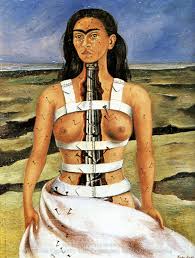
Pain and suffering is a constant topic in Frida’s painting. In this painting, The Broken Column, Frida expressed her anguish ans suffering in a most straightforward and horrifying way. In this painting Frida looks pretty and strong. Although her whole body is supported by the corset, she is conveying a message of spiritual triumph. She has tears on her face but she looks straight ahead and is challenging both herself and her audience to face her situation.
The style of this painting is very unique. She laid down each stroke firmly to build a simple and clear image. There are no virtuoso flourishes of the brush and the colors are as neatly contained within contours. At the beginning she paints herself nude but later covered her lower part up with something that looks like a hospital sheet. A broken column is put in place of her spine. The column appears to be on the verge of collapsing into a rubble. Penetrating from loins to chin, the column looks phallic, and the sexual connotation is all the more obvious because of the beauty of Frida’s breasts and torso. There is a difference between isolation and solitude.
The painting portrays her strong character and depicts the pain that she’s gong through. This Canvas work is considered to be one of the best artwork till date.


 The Artidote